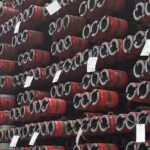
H40 Casing Supplier in China

Common Size for H40 Casing
H40 is the lowest-strength grade in API 5CT, requiring no heat treatment and making it the most cost-effective option for shallow, low-pressure, non-corrosive wells. It is not recommended for sour service (H₂S) environments and is exempt from hardness and impact testing requirements.
- Applicable Product-Only Casing:4½”–20″.
- Thread Types:BC,STC / LTC.
- Available Lengths:R1 / R2 / R3.
| Element | Requirement |
| Carbon (C) | Not specified (no restriction) |
| Manganese (Mn) | Not specified |
| Phosphorus (P) | ≤ 0.030% |
| Sulfur (S) | ≤ 0.030% |
| Property | Requirement |
| Minimum Yield Strength | 276 MPa (40,000 psi) |
| Maximum Yield Strength | 552 MPa (80,000 psi) |
| Minimum Tensile Strength | 414 MPa (60,000 psi) |
| Minimum Elongation | Per API 5CT Table C.6 (elongation formula) |
| Hardness | Not specified |
| Property | Requirement |
| Process | Seamless or Electric Weld (EW) |
| Heat Treatment | None required |
| Test | Scope | Purpose |
| Flattening Test | Electric-weld (EW) pipe only | Verify weld integrity and ductility of the pipe body |
| Hydrostatic Test | Each pipe | Confirm pressure integrity |
| Dimensional Inspection | Each pipe | Verify OD, wall thickness, length, and weight |
H40 Casing Specifications and Price List
| Size Inch | LB/FT PPF | OD mm | NLM kg/m | WT mm | ID mm | Drift mm | PE kg/m | Material | Connection | EXW Price Usd/ft | EXW Price Usd/M |
|---|
H40 vs Other Grades
How Does H40 Casing Compare to Other API 5CT Grades?
Selecting the right casing grade starts with understanding the mechanical and operational differences between grades. The table below compares H40 against the most commonly used API 5CT casing grades to help you make an informed sourcing decision.
| Grade | Min. yield strength | Max. yield strength | Min. tensile strength | Heat treatment | Sour service | Typical application |
|---|---|---|---|---|---|---|
| H40 | 276 MPa 40,000 psi | 552 MPa 80,000 psi | 414 MPa 60,000 psi | None | Not recommended | Shallow, low-pressure wells |
| J55 | 379 MPa 55,000 psi | 552 MPa 80,000 psi | 517 MPa 75,000 psi | None | Not recommended | Moderate-depth, non-corrosive wells |
| K55 | 379 MPa 55,000 psi | 552 MPa 80,000 psi | 655 MPa 95,000 psi | None | Not recommended | Moderate-depth, improved toughness |
| N80 | 552 MPa 80,000 psi | 758 MPa 110,000 psi | 689 MPa 100,000 psi | Normalizing or Q&T | Not recommended | Medium-depth wells |
| L80 | 552 MPa 80,000 psi | 655 MPa 95,000 psi | 655 MPa 95,000 psi | Q&T required | Mild sour service | Mild H₂S environments |
| P110 | 758 MPa 110,000 psi | 965 MPa 140,000 psi | 862 MPa 125,000 psi | Q&T required | Not recommended | Deep, high-pressure wells |
H40 VS J55
H40 and J55 are both carbon steel grades requiring no heat treatment, but they serve different purposes. H40 is the right choice when well depth is shallow (typically under 1,500 m), formation pressure is low, and budget optimization is the primary driver. J55 is preferred when moderate tensile loads are anticipated or when the purchaser specifies a higher minimum tensile strength for string design. If your well program does not require the additional strength of J55, H40 delivers the same dimensional compliance at a lower material cost.

H40 Casing Inspection & Testing
The most basic inspection requirements for H40 casing pipe;
| Chemical Analysis | Mechanical Testing | Hydrostatic Test | Flattening Test | Dimension Inspection | Non-Destructive Examination | Thread Inspection | Documentation & Marking | Third-Party Inspection |
| Must | Must | Must | Must | Must1 | Negotiable2 | Must | Must | Pending |
1.Each pipe undergoes dimensional inspection covering outside diameter (OD) and ovality, wall thickness uniformity, pipe length (R1/R2/R3), and drift diameter to ensure full bore clearance for downhole tools.
2.API 5CT allows the purchaser to negotiate with the manufacturer to exempt H40, J55, and K55 grade couplings from non-destructive testing requirements.
Get Your H40 Casing Pipe in China!
H40 Casing Features & Applications
Where H40 Performs Best
H40 casing is widely selected for well programs where formation pressures are low and corrosive conditions are absent.
Shallow Oil & Gas Wells
Surface casing and conductor pipe in low-pressure formations where minimal yield strength is required.
Water Wells
Municipal and agricultural water supply projects requiring reliable, cost-effective casing solutions.
Geothermal Wells
Low-temperature, low-pressure geothermal drilling programs where H40’s economical profile is ideal.
Coal Bed Methane Wells
Surface and intermediate casing in shallow CBM projects where formation pressures remain moderate.
Structural Applications
Non-production uses where API-grade pipe is specified for structural integrity without downhole service demands.
H40 casing is primarily used in shallow, low-pressure oil and gas wells, water wells, geothermal wells, and surface casing applications where formation pressures are moderate and corrosive conditions such as H₂S or high CO₂ are absent. Its low cost and simple manufacturing process make it the preferred choice for budget-sensitive drilling programs.
The primary difference lies in minimum yield strength. H40 has a minimum yield strength of 40,000 psi, while J55 requires a minimum of 55,000 psi. Both grades require no heat treatment, but J55 offers greater tensile capacity, making it more suitable for moderately deeper wells or applications with higher string weight. H40 is the more economical option when the additional strength of J55 is not required by the well design.
No. H40 casing is not recommended for sour service applications. Wells containing hydrogen sulfide (H₂S) require grades specifically designed and tested for sulfide stress cracking (SSC) resistance, such as L80-1, C90, or T95, which comply with NACE MR0175 / ISO 15156 requirements.
H40 casing is available with API Short Round Thread Casing (STC), API Long Round Thread Casing (LTC), and API Buttress Thread Casing (BTC). STC is the most commonly specified connection for H40 due to its cost-effectiveness and wide availability. BTC may be selected when higher tensile efficiency is needed.
H40 casing is available in outside diameters ranging from 4½” (114.30 mm) to 20″ (508.00 mm), covering a wide range of wall thicknesses and nominal linear masses in accordance with API 5CT Table C.18. Common stock sizes include 5½”, 7″, 9⅝”, and 13⅜”.
H40 casing price varies depending on size, wall thickness, connection type, order quantity, and prevailing steel market conditions. As a general reference, FOB prices for H40 casing from Chinese mills typically range from USD 550 to 700 per metric ton. Contact us directly for an up-to-date price indication based on your specific requirements.
For standard sizes in stock, lead time is typically 7–15 days from order confirmation. For non-stock sizes or large-volume orders requiring mill production, lead time is generally 30–45 days, depending on mill scheduling and pipe specification.
Yes. We support third-party inspection by internationally recognized agencies including SGS, Bureau Veritas (BV), and TÜV Rheinland. Inspection scope can include dimensional verification, hydrostatic testing, tensile testing, and review of mill test certificates, in line with API 5CT PSL-1 or PSL-2 requirements.