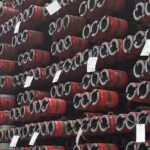
L80 13Cr is a martensitic stainless steel grade defined under API 5CT, with a controlled yield strength of 80,000–95,000 psi and a minimum tensile strength of 95,000 psi. L80 13Cr was specifically developed for corrosive downhole environments, offering superior resistance to CO₂ corrosion compared to conventional carbon steel grades, making L80 13Cr tubing the preferred choice for sour and CO₂-rich oil and gas wells worldwide.
API 5CT l80 13cr Pipes & Tubes Chemical Composition
Element
Requirement
C
0.150–0.220
Mn
0.250–1.000
Cr
12.000–14.000
Ni
≤ 0.500
Cu
≤ 0.250
P
≤ 0.020
S
≤ 0.010
Si
≤ 1.000
Mo
Not specified
Ti / V / Al
Not specified
Mechanical Properties
Property
Requirement
Yield Strength
552–655 MPa
Yield Strength
80,000–95,000 psi
Tensile Strength
≥ 655 MPa
Tensile Strength
≥ 95,000 psi
Total Elongation Under Load
≥ 0.5 %
Hardness
≤ 23 HRC
Hardness
≤ 241 HBW
Testing and Inspection Requirements — L80 13Cr — octgcasing.com
API 5CT · L80 13Cr Tubing
Testing & Inspection Requirements
Complete checklist of tests, acceptance criteria, and inspection items for L80 13Cr OCTG tubing procurement.
4.1 Chemical Analysis
The material test certificate must report chemical composition for each heat and confirm compliance with L80 13Cr limits.
Test
Requirement
Heat analysis
Required
Product analysis
Recommended or required per purchase specification
Elements to report
C, Mn, Cr, Ni, Cu, P, S, Si, and any intentionally added elements
4.2 Tensile Test
Tensile testing verifies the mechanical properties meet the published 13Cr-L80 range.
Property
Acceptance Criteria
Yield strength
552 – 655 MPa
Tensile strength
≥ 655 MPa
Elongation under load
≥ 0.5 %
4.3 Hardness Test
Hardness testing is mandatory. Both pipe body and heat-affected / processed areas must remain within the maximum limit.
Method
Maximum Limit
Rockwell C
≤ 23 HRC
Brinell
≤ 241 HBW
4.4 Impact Test / CVN
Charpy V-notch impact testing should be specified per API 5CT and purchase order requirements.
Item
To Be Specified
Test temperature
As per API 5CT / purchase order
Specimen orientation
Longitudinal or transverse, as applicable
Absorbed energy
Per grade, size, wall thickness, and project requirement
Note: For critical wells, low-temperature service, or heavy-wall tubing, the CVN requirement should be clearly stated in the purchase order.
4.5 Hydrostatic Test
Tubing should be hydrostatically tested unless the specification or purchase order allows an approved alternative.
Item
Required Detail
Test pressure
API 5CT value or project-specific value
Holding time
As specified
Leakage acceptance
No leakage
Alternative NDE
Only if permitted and agreed
4.6 Non-Destructive Examination (NDE)
For L80 13Cr tubing, the following NDE requirements are normally specified.
Inspection Area
Inspection Type
Full pipe body
Longitudinal defect detection
Full pipe body
Transverse defect detection
Internal & external surfaces
Surface imperfection detection
Pipe ends
End-area NDE / visual / dimensional inspection
Threads (if applicable)
Thread inspection and gauging
For higher service severity, specify enhanced NDE levels, full-length inspection, end-area inspection, and acceptance levels in the purchase specification.
4.7 Dimensional Inspection
Dimensional inspection should cover all of the following items.
Outside diameter
Wall thickness
Length
Straightness
Weight
Drift test
End finish
Thread dimensions (if threaded)
Coupling dimensions (if supplied with coupling)
4.8 Surface Condition
Internal surface cleanliness is critical — iron contamination, heavy scale, or embedded carbon steel particles can reduce corrosion performance of 13Cr material.
Surface Item
Requirement
Internal surface
Clean, free from harmful scale and contamination
External surface
Free from injurious defects
Pickling / blasting
To be agreed in the purchase order
Iron contamination
Avoid carbon-steel contamination on 13Cr surfaces
4.9 SSC / H₂S Testing
API 5CT L80 13Cr should not automatically be assumed suitable for sour service. Standard L80 13Cr is commonly associated with CO₂ corrosion resistance, but sour-service suitability depends on actual well conditions.
Important: For wells containing H₂S, the purchase specification must clearly state whether the material must comply with NACE MR0175 / ISO 15156 and project-specific SSC test conditions.
Purchase Specification Must State
Standard compliance
NACE MR0175 / ISO 15156
Test method
NACE TM0177 Method A testing
SSC test condition
Project-specific
H₂S partial pressure
To be specified
Chloride concentration
To be specified
pH
To be specified
Test stress level
To be specified
Temperature
To be specified
Available Sizes and Specifications — L80 13Cr — octgcasing.com
API 5CT · L80 13Cr
Available Sizes and Specifications
Common tubing and casing sizes, weight classes, thread types, and premium connections for L80 13Cr OCTG products.
13Cr Tubing and Casing Pipe
L80 13Cr tubing is available in a wide range of OD sizes, weight classes, and thread configurations. Below are common specifications frequently ordered for CO₂-corrosive well environments.
Premium Connections for 13Cr Tubing and Casing Pipe
Thread selection is critical for 13Cr applications. The connection must provide reliable sealing, torque resistance, and compatibility with CRA material handling requirements.
EUE — External Upset End API 5CT Standard Connection
The most widely used API connection for L80 13Cr tubing. The 8-round thread profile with external upset provides a robust, field-proven joint for standard CO₂ service conditions.
API 5B 8-round thread — widely available, interchangeable
External upset increases joint strength
Requires thread compound for seal — not metal-to-metal
Suitable for standard pressure and mild CO₂ environments
Best for
STANDARD CO₂ WELLSMODERATE PRESSURECOST-EFFECTIVE
VAM TOP Nippon Steel · Premium Connection
A widely adopted premium connection with metal-to-metal seal and high torque shoulder. VAM TOP provides gas-tight integrity and is one of the most commonly specified premium threads for 13Cr casing and tubing.
Metal-to-metal seal — gas-tight to API 5C5 CAL IV
Torque shoulder for controlled make-up
Flush / semi-flush OD — good clearance in tight annulus
High compression and bending resistance
Best for
HIGH-PRESSURE GASDEVIATED WELLSCRA APPLICATIONS
Other Premium Connections TenarisHydril · JFE · Hunting · Marubeni-Itochu
Multiple proprietary premium connection systems are qualified for L80 13Cr service. Selection depends on well conditions, operator preference, and regional availability.
JFE Bear: JFEBEAR series — suited for CRA material
Hunting SEAL-LOCK: Metal-to-metal, high torque make-up
NK 3SB / KSBEAR: Nippon Steel proprietary for deepwater
Best for
HP/HT WELLSDEEPWATERSOUR SERVICEEXTENDED REACH
When specifying premium connections for 13Cr, always confirm the connection is qualified for CRA material (torque values, thread compound, and handling procedures differ from carbon steel). Ensure the thread compound is 13Cr-compatible and does not introduce iron contamination.
L80 13Cr martensitic stainless steel tubing is the go-to CRA solution for CO₂-dominant downhole environments where carbon steel grades like J55 and N80 fail due to accelerated corrosion.
L80 13Cr tubing and casing at wellhead — designed for CO₂-rich and high-temperature downhole environments
CO₂-Rich Oil & Gas Wells
13Cr’s passive chromium oxide layer resists CO₂ corrosion at rates 10–100× lower than J55/N80 carbon steel, eliminating the need for continuous inhibitor injection in high-CO₂ production strings.
CO₂ PARTIAL PRESSURE >30 PSIPRODUCTION TUBING
Mildly Sour Service (Low H₂S)
Standard L80 13Cr is acceptable for mild sour conditions with low H₂S partial pressure, moderate chlorides, and controlled pH. Always verify against NACE MR0175 / ISO 15156 limits for your specific well chemistry.
LOW H₂SNACE MR0175 QUALIFIED
High-Temperature Downhole
L80 13Cr retains its yield strength (552–655 MPa) and corrosion resistance at bottomhole temperatures up to 150–180°C, where carbon steel corrosion rates accelerate exponentially without heavy inhibition.
UP TO 180°C BHTDEEP WELLS
Offshore Platforms
On offshore platforms where workover intervention is costly, 13Cr tubing delivers a 20+ year service life with minimal corrosion maintenance — reducing total well lifecycle cost versus carbon steel with inhibitor programs.
OFFSHORELOW LIFECYCLE COST
10–100× Lower Corrosion Rate
vs. J55/N80 in CO₂ environments
No Continuous Inhibitor
Eliminates chemical injection opex
20+ Year Service Life
Reduced workover and replacement cost
Same YS as L80 Carbon
552–655 MPa — no strength penalty
Grade Comparison
L80 13Cr vs. Other Steel Grades
How does API 5CT L80 13Cr stack up against austenitic stainless steels and carbon steel? The table below compares chromium content, mechanical properties, corrosion resistance, and cost positioning to help you select the right grade.
Property
Carbon Steel (J55/N80)
L80 13Cr (API 5CT)
AISI 410
SS 304
SS 316
Steel Type
Carbon / low-alloy
Martensitic stainless
Martensitic stainless
Austenitic stainless
Austenitic stainless
Cr Content (%)
≤ 0.5
12.0 – 14.0
11.5 – 13.5
18.0 – 20.0
16.0 – 18.0
Ni Content (%)
—
≤ 0.5
≤ 0.75
8.0 – 10.5
10.0 – 14.0
Mo Content (%)
—
—
—
—
2.0 – 3.0
Yield Strength
379–552 MPa
552–655 MPa
≥ 275 MPa (annealed)
≥ 205 MPa
≥ 205 MPa
Tensile Strength
517–689 MPa
≥ 655 MPa
≥ 450 MPa
≥ 515 MPa
≥ 515 MPa
Hardness
≤ 22 HRC
≤ 23 HRC
Varies (up to 40 HRC)
≤ 92 HRB
≤ 95 HRB
CO₂ Corrosion Resistance
Poor
Excellent
Good
Excellent
Excellent
H₂S / Sour Resistance
Limited
Mild only
Limited
Good
Very Good
Chloride Pitting
Poor
Moderate
Moderate
Good
Excellent
Relative Cost
$ — Lowest
$$ — Mid-range
$$ — Mid-range
$$$ — High
$$$$ — Highest
API 5CT Covered
Yes (J55, N80)
Yes (L80 Type 13Cr)
No (ASTM A268)
No (ASTM A312)
No (ASTM A312)
Typical Use Case
SWEET SERVICELOW COST WELLS
CO₂ WELLSOFFSHOREHP/HT
GENERAL INDUSTRIALVALVES
CHEMICAL PLANTFOOD PROCESSING
MARINEPHARMASEVERE CORROSION
Key takeaway: L80 13Cr delivers CO₂ corrosion resistance comparable to SS304/SS316 at roughly half the material cost, with significantly higher yield strength for downhole pressure containment. It is the cost-performance sweet spot for CO₂-dominant wells — but is not a direct substitute for austenitic grades in high-chloride or severe sour service.
TIs 13Cr the same as 410?
No. 13Cr and AISI 410 are not exactly the same, although they have similar chromium content, typically around 12–14% Cr.
AISI 410 is a general-purpose martensitic stainless steel, while 13Cr under API 5CT is specifically designed for OCTG applications, such as tubing and casing used in downhole oil and gas wells. Compared with standard 410 stainless steel, 13Cr L80 has defined API 5CT requirements for chemical composition, heat treatment, yield strength, tensile strength, hardness, and testing.
Is 13Cr better than SS316?
SS316 is better for many general corrosive environments, while 13Cr is often more suitable for high-strength OCTG service in CO₂-containing wells. Final selection depends on CO₂, H₂S, chloride content, pH, temperature, pressure, and required mechanical strength.
What is the difference between 13Cr and SS304?
SS304 is better for general fabrication and forming, while 13Cr is designed for high-strength oilfield tubular service.
What is the density of 13Cr?
7.7 g/cm³, or about 0.278 lb/in³.
What is the difference between 13Cr and Stellite 6?
13Cr is a structural tubular steel, while Stellite 6 is a wear-resistant hardfacing alloy. They are not interchangeable and are selected for entirely different service conditions.