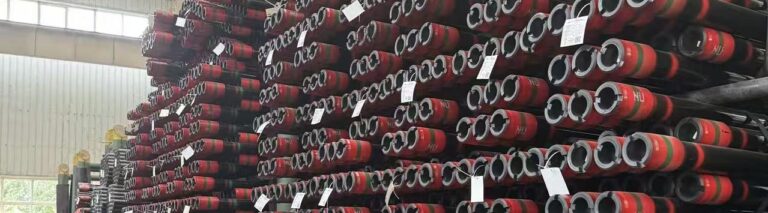
API Casing Chart: Complete Guide to API Casing Sizes, Weights, Grades and Specifications


In oil and gas well construction, API casing refers to steel pipe manufactured according to American Petroleum Institute standards and used to support the wellbore, isolate formations, and ensure safe drilling and production operations. Because casing selection involves multiple technical factors, engineers, buyers, and field personnel often refer to an api casing chart to quickly compare key data across different casing options. A typical oilfield casing chart summarizes essential information such as outside diameter, nominal weight, wall thickness, steel grade, drift size, burst pressure, collapse pressure, and connection details.
What Is an API Casing Chart?
An API casing chart is a standardized reference table published under API Specification 5CT (ISO 11960) that lists the complete dimensional, mechanical, and weight data for every casing and tubing size, wall thickness, and grade recognized by the American Petroleum Institute. It is the single most important reference document used across the OCTG supply chain — from well design to final field installation.
Every row in an API casing chart defines a specific pipe configuration by its key dimensions: the outside diameter (OD), wall thickness, and the resulting unit weight in lb/ft or kg/m. But the chart goes far beyond these basics — it also specifies tolerances and quality parameters that ensure every joint of casing arriving on a rig floor is fit for purpose in a high-pressure downhole environment.
Engineers, procurement teams, and field crews rely on the API casing chart at every stage of a well’s life. During design, it provides the data needed to run casing string calculations for burst, collapse, and tensile loads. During procurement, it standardizes what buyer and supplier agree on. And on location, it gives rig crews the drift diameter and coupling dimensions they need to confirm the pipe is ready to run.
Well Design
Burst, collapse & tensile calculations
Casing Selection
Grade and size specification
Procurement
Standard specs for buyer & supplier
Engineering Calculations
Hook load, string weight, torque
Field Operations
Drift check, tally & running verification
Request a Quote
Need a specific size, grade, or connection? Send us your requirements — we’ll respond within 24 hours.
API Casing Dimensions
API Casing Size and Weight Selector
Choose a casing size label and weight label to view matching outside diameter, nominal mass, wall thickness, inside diameter, drift diameter, plain-end mass, and thread values in inch or metric units.
Matching Result
No size and weight selected.
Inquiry List
0 itemsAdd one or more casing specifications before sending an RFQ.
API Casing Size Chart Lookup
This API casing selector uses size label and weight label data from a casing pipe dimensions and weight chart for API round thread and buttress thread products. The selector helps buyers compare inch and metric casing dimensions before requesting a quotation.
The displayed values include outside diameter, nominal linear mass, wall thickness, inside diameter, drift diameter, plain-end mass, round thread values, and buttress thread values. Blank cells indicate that the source chart does not list a value for that casing specification.
How to use this casing selector
- Select Inch or Metric according to the unit system required for your casing inquiry.
- Choose a Size label, then choose an available Weight label from the filtered list.
- Review the matching result and add one or more casing specifications to the inquiry list.
- Use the RFQ email button to send the selected API casing specifications to info@balingpipe.com.
save and use you at anytime for your casing pipe
API Tubing Dimensions
API Tubing Size Selector
Choose the OD and PPF to view matching standard tubing dimensions, metric masses, wall thickness, inside diameter, and API tubing connection mass gain or loss data.
Matching Result
No OD and PPF selected.
Inquiry List
0 itemsAdd one or more tubing specifications before sending an RFQ.
save and use you at anytime for your tubing pipe
API Casing Grade Chart
| Grade | Typical Application | Yield Strength MPa | Tensile Strength MPa | Hardness Requirement | Heat Treatment |
| H40 | Shallow wells, low-load wells | 276–552 | ≥414 | — | Hot rolled |
| J55 | Shallow wells, conventional wells | 379–552 | ≥517 | ≤207 HB | Normalized |
| K55 | Medium-shallow wells, wells requiring higher tensile strength | 379–552 | ≥655 | ≤207 HB | Normalized |
| M65 | Sour wells, low-strength sour-service conditions | 448–586 | ≥586 | ≤22 HRC | Quenched and tempered |
| N80-1 | Deep wells, conventional high-load wells | 552–758 | ≥689 | ≤241 HB | Normalized |
| N80-Q | Deep wells, wells requiring higher toughness | 552–758 | ≥689 | ≤241 HB | Quenched and tempered |
| L80-1 | Sour wells, anti-sulfur wells | 552–655 | ≥655 | ≤23 HRC | Quenched and tempered |
| L80-9Cr | CO₂ corrosion wells | 552–655 | ≥655 | ≤23 HRC | Quenched and tempered |
| L80-13Cr | CO₂ corrosion wells, mild to moderate corrosive wells | 552–655 | ≥655 | ≤23 HRC | Quenched and tempered |
| C90-1 | High-pressure sour wells | 621–724 | ≥689 | ≤25.4 HRC | Quenched and tempered |
| T95-1 | High-temperature, high-pressure sour wells | 655–758 | ≥724 | ≤25.4 HRC | Quenched and tempered |
| P110 | Ultra-deep wells, high-load wells | 758–965 | ≥862 | — | Quenched and tempered |
| Q125 | Ultra-deep wells, ultra-high-pressure wells | 862–1034 | ≥931 | ≤321 HB | Quenched and tempered |
How to Use an API Casing Chart for Casing Selection
Selecting the right oil casing pipe requires more than matching the nominal outside diameter. An API casing chart helps engineers compare casing size, weight, wall thickness, inside diameter, drift size, and pipe body dimensions, then match these values with well depth, pressure, load conditions, corrosion environment, and required mechanical performance. The following steps explain how to use an API casing chart for casing selection.
1
Confirm the Well Depth and Casing Section
Start by identifying the well depth and which casing section is being installed — surface, intermediate, production, or liner. Deeper wells require higher strength, heavier wall thickness, and better collapse resistance because external pressure and axial loads increase with depth.
For each casing string, define the setting depth, hole size, previous casing size, cementing requirements, and the required internal clearance for drilling or production tools.
2
Determine the Required Casing Size
Use the casing chart to select the nominal outside diameter — such as 7″, 9-5/8″, 13-3/8″, or 20″ casing. The selected OD must fit the wellbore design, allow proper cement clearance, and provide enough inside diameter for tools, completion equipment, tubing, packers, or production flow.
Don’t select by OD alone — the same OD may have several weight options, each with a different wall thickness, ID, and drift size.
3
Compare Nominal Weight and Wall Thickness
After selecting the OD, compare the available nominal weights in the casing chart, usually shown in lb/ft. A higher nominal weight normally means a thicker wall, smaller inside diameter, and higher pipe body strength.
A heavier casing weight may improve burst, collapse, and tensile performance — but it also reduces internal clearance and increases total string weight. The selected weight must balance mechanical strength, drift requirement, running conditions, and cost.
4
Check Inside Diameter and Drift Size
The inside diameter shows the available internal bore. The drift diameter is the minimum guaranteed diameter that a standard drift mandrel can pass through.
Always compare the drift size with the maximum outside diameter of tools that must pass through — drill bits, logging tools, perforating guns, packers, plugs, tubing, and completion assemblies. The drift size should be larger than the maximum tool OD with enough clearance.
If the drift size is too small, the casing may meet strength requirements but still fail operationally — downhole tools cannot pass through safely.
5
Evaluate Burst Pressure Requirement
Burst pressure is the internal pressure capacity of the casing. It becomes critical when the pressure inside the casing is higher than the external formation or annulus pressure.
Calculate the maximum expected internal pressure during drilling, testing, stimulation, production, or well control conditions. Then compare it with the pipe body burst rating for the selected OD, weight, and grade.
If the burst rating is insufficient, select a heavier weight, thicker wall, or higher-strength grade.
6
Evaluate Collapse Pressure Requirement
Collapse pressure is the casing’s resistance to external pressure. It is especially important in deep wells, depleted formations, high-mud-weight wells, and cementing operations.
Calculate the maximum external pressure and minimum internal pressure that the casing may experience. Then compare with the collapse rating of the selected size, weight, and grade.
If collapse resistance is too low, choose a heavier wall, higher grade, or a casing design with improved collapse performance.
7
Check Axial Load and Tensile Capacity
Casing must support its own weight plus additional loads from running, cementing, pressure testing, thermal effects, bending, drag, and possible overpull. The deeper the well, the more important tensile capacity becomes.
Use the casing weight from the chart to estimate total string weight. Then compare the expected axial load with the pipe body yield strength and connection strength. The selected grade and connection type must provide adequate tensile capacity with the required safety factor.
8
Select the Proper API Grade
Casing grade determines the material strength and directly affects burst, collapse, and tensile performance. Common API casing grades include J55, K55, N80, L80, P110, and Q125.
For shallow or low-pressure wells, lower grades may be sufficient. For deep, high-pressure, or high-load wells, higher grades are needed.
Grade selection must also consider corrosion and sour service conditions — in H₂S, CO₂, or high-chloride environments, material compatibility may matter more than simply choosing the highest strength grade.
9
Consider the Corrosion Environment
Before finalizing casing selection, evaluate the corrosion environment — H₂S, CO₂, chlorides, water cut, oxygen exposure, temperature, and expected well life.
For corrosive wells, consider sour-service grades (L80, C90, T95), corrosion-resistant alloys (13Cr, Super 13Cr, duplex), coating, inhibitor programs, or additional corrosion allowance.
A casing that is mechanically strong may not be suitable if it cannot withstand the actual downhole chemical environment.
10
Verify Connection and Thread Type
The casing chart lists pipe body dimensions, but the final selection must also include the connection type — STC, LTC, BTC, or premium connections.
The connection must meet the same design requirements as the pipe body: tension, compression, internal pressure, external pressure, sealing performance, torque capacity, and running conditions.
For high-pressure gas wells, horizontal wells, or severe service wells, premium connections with metal-to-metal seals are often required.
11
Compare All Design Parameters Together
Final casing selection should be based on the combined result of all key parameters — well depth, formation pressure, burst requirement, collapse requirement, axial load, corrosion environment, OD and wall thickness, nominal weight, API grade, ID and drift size, connection type, and cementing and running requirements.
The best casing is not always the heaviest or highest grade — it is the one that satisfies pressure, load, corrosion, drift, and operational requirements with the proper safety margin and reasonable cost.
12
Finalize the Casing Selection
Once the candidate casing size, weight, and grade meet the required burst, collapse, tensile, drift, and corrosion criteria, confirm the selection against API 5CT specifications, project design standards, and manufacturer performance data.
The API casing chart should be used as the starting point for dimensional selection, while burst, collapse, tensile, and connection performance should be verified using approved engineering data before procurement or field use.
Check API Casing and Tubing Size with BSCO
When selecting oilfield casing, accurately understanding its dimensions, weight, steel grade, thread type, and applicable operating conditions is crucial for ensuring the safe and efficient progress of oil and gas projects. The API Casing Chart allows you to quickly compare casing parameters across different specifications, providing a reference for design, procurement, and cost control.
If you are still unsure which casing specification is best suited for your project, please contact BSCO. With extensive industry experience and professional technical support, BSCO can provide you with suitable oilfield casing size recommendations, specification selection solutions, and price consultations based on your well conditions, project needs, and budget, helping you reduce your project procurement burden and more efficiently complete budget planning and material preparation.
Frequently Asked Questions (FAQs)
DescriptionAn API casing chart usually includes key casing data such as outside diameter, wall thickness, nominal weight, inside diameter, drift diameter, coupling size, grade, and connection type.
An API tubing chart focuses on tubing dimensions and specifications, which are mainly used to transport oil, gas, or other fluids from the wellbore to the surface.
In contrast, an API casing chart provides casing sizes and structural data for supporting and protecting the wellbore.
You can usually find an API casing table PDF from BSCO pipe manufacturers, OCTG suppliers, technical manuals, and oilfield engineering references.
https://octgcasing.com/wp-content/uploads/2026/06/API-Tubing-Sizes-and-Standard-Size-Range.pdf
https://octgcasing.com/wp-content/uploads/2026/06/API-Casing-Sizes-and-Standard-Size-Range.pdf
An API casing drift chart shows the minimum drift diameter of casing, which is used to confirm whether tools, equipment, or tubing can pass through the casing bore. The API drift size chart is especially important in well completion and intervention operations because it helps prevent tool restriction, clearance issues, and operational delays.
Reference Sources
Organization: American Petroleum Institute (API)
Type: Industry Standard / Specification
Publication Year: Latest official standard page / 11th Edition
Citation Token: (API 5CT)
Nofollow Link: https://www.api.org/products-and-services/standards/important-standards-announcements/spec5ct
Organization: International Organization for Standardization (ISO)
Type: International Standard
Publication Year: 2020
Citation Token: (ISO 11960)
Nofollow Link: https://www.iso.org/standard/75278.html
Organization: International Organization for Standardization (ISO)
Type: Technical Report / Engineering Calculation Reference
Publication Year: 2018
Citation Token: (ISO/TR 10400)
Nofollow Link:https://www.iso.org/standard/75259.html
Organization: International Organization for Standardization (ISO)
Type: International Standard / Sour Service Material Selection
Publication Year: 2020
Citation Token: (ISO 15156-2 / NACE MR0175)
Nofollow Link: https://www.iso.org/standard/79659.html