API 5CT L80 Casing Pipe
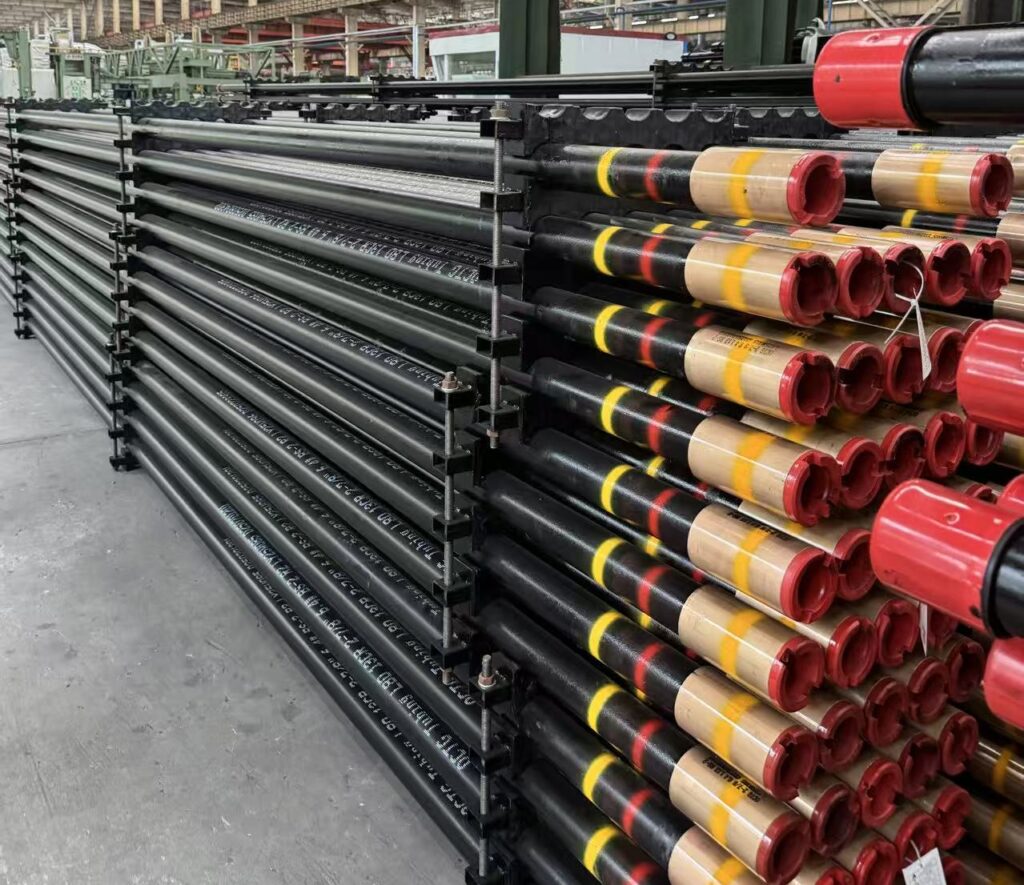
Premium API 5CT L80 Casing Pipe for Oil & Gas Applications
L80 is a quench-and-tempered grade family defined under API 5CT, with a controlled yield strength of 80,000–95,000 psi and a minimum tensile strength of 95,000 psi across all variants. L80-1, the base carbon steel sub-grade, provides consistent mechanical properties and basic H₂S resistance suitable for mildly sour wells. L80 9Cr adds a 9% chromium, 1% molybdenum alloy composition that significantly improves CO₂ corrosion resistance for wells producing corrosive gas streams, offering an economical step up without committing to full stainless grades. L80 13Cr takes corrosion performance further with 13% chromium martensitic stainless steel, forming a stable passive oxide layer that delivers outstanding resistance in sweet-gas and high-CO₂ reservoirs — making it the preferred choice where carbon and low-alloy steel grades would experience rapid degradation.
- Material Grade:L80-1,L80 9Cr,L80 13Cr
- Applicable Product: Casing & Tubing 4½″–20″.
- Thread Types: BC, STC / LTC, Premium Connections.
- Available Lengths: R1 / R2 / R3.
Chemical Composition of API 5CT L80
| Standard | Color Ring | Grade | Chemical Composition % | ||||||||
| C | Si | Mn | P | S | Cr | Mo | Ni | Cu | |||
| API SPEC 5CT | 
| L80-1 | ≤0.43 | — | ≤1.90 | ≤0.030 | ≤0.030 | — | — | — | — |

| L80 9Cr | ≤0.15 | ≤1.00 | 0.30–0.60 | ≤0.020 | ≤0.010 | 8.00–10.00 | 0.90–1.10 | ≤0.50 | ≤0.25 | |

| L80 13Cr | 0.15–0.22 | ≤1.00 | 0.25–1.00 | ≤0.020 | ≤0.010 | 12.00–14.00 | — | ≤0.50 | ≤0.25 | |
Mechanical Properties of API 5CT L80 Pipe
| Standard | Grade | Yield Strength MPa | Tensile Strength MPa | Elongation % | Hardness max | ||
| min | max | min | min | HRC | HBW | ||
| API SPEC 5CT | L80-1 | 552 | 655 | 655 | ≥19% | 23 | 241 |
| L80 9Cr | 552 | 655 | 655 | 23 | 241 | ||
| L80 13Cr | 552 | 655 | 655 | 23 | 241 | ||
Charpy Impact Energy of API 5CT L80
According to the API 5CT standard, there is no mandatory Charpy impact energy requirement for L80 class (including L80-1, 9Cr, and 13Cr).
| Standard | Grade | Charpy Impact Energy J | |||
| Coupling | Pipe Body | ||||
| L | T | L | T | ||
| API SPEC 5CT | L80-1 | L-10-40-0 | T-10-20-0 | L-10-27-0 | T-10-14-0 |
| L80 9Cr | L-10-40-0 | T-10-20-0 | L-10-27-0 | T-10-14-0 | |
| L80 13Cr | L-10-40-0 | T-10-20-0 | L-10-27-0 | T-10-14-0 | |
API 5CT L80 Casing Pipe Dimension
Tubing & Casing — Cascading Filter with Tolerance Data
PRODUCT FILTER
1 Product Type
2 Outside Diameter (OD)
3 Wall Thickness / Weight
4 Length Range
Unit System
Select a product type to begin
Start Your Search
Select Tubing or Casing to begin browsing specifications.
Tolerance Data
Basic Types of API 5CT Grade L80 Steel Pipe
L80 Casing & Tubing Grade Comparison
H₂S & CO₂ resistance · Relative cost · Lead time · Typical applications
| Grade | H₂S Resistance | CO₂ Resistance | Relative Cost | Lead Time | Typical Applications |
|---|---|---|---|---|---|
| L80 Type 1 |
|
Short | Standard oil & gas wells, water injection wells | ||
| L80 9Cr |
|
Medium | Moderate CO₂ corrosion wells | ||
| L80 13Cr |
|
Long | High CO₂ environments, corrosive gas wells |
H₂S resistance (green)
CO₂ resistance (blue)
Cost (green → red = higher)
L80 Type 1 Standard Carbon Steel Casing
- Material: High-quality carbon manganese steel.
- Positioning: The most economical L80 solution.
- Application Scenarios: Suitable for standard oil and gas wells at greater depths with a slight H2S (hydrogen sulfide) risk.
- Technical Highlights: Strict microstructure homogeneity control provides reliable resistance to hydrogen sulfide stress cracking (SSC).
- BSCO Procurement Recommendation: If your well condition is a conventional acidic environment, Balingsteel’s L80-1 offers excellent value for money. When purchasing, please confirm whether Balingsteel special threads (BS-2) are required to replace standard API threads and enhance gas tightness.The model that customers frequently purchase is “oil well casing steel pipe API 5CT L80 BTC R3.
L80 9Cr Standard Carbon Steel Casing
- Material: Low-alloy steel containing 9% chromium.
- Positioning: A “bridge” with performance between carbon steel and stainless steel.
- Application Scenarios: Specifically designed for environments containing carbon dioxide (CO2) at moderate temperatures.
- Technical Highlights: Compared to Type 1, its resistance to uniform corrosion (thinner pipe wall) is significantly improved, making it suitable for applications where 13Cr is not worthwhile but carbon steel cannot withstand the corrosion.
- BSCO Procurement Recommendation: Balingsteel’s 9Cr is a highly customized product, and its inventory is usually less abundant than 13Cr. If your project requires it, it is recommended to place an order at least 3-4 months in advance.
API 5CT L80 13Cr Pipe for Corrosive Environments
- Material: High-chromium martensitic stainless steel.
- Positioning: Top-tier CO2 resistance solution.
- Application Scenarios: Highly corrosive environments. If your well contains large amounts of wet carbon dioxide (CO2), 13Cr is the only industry-standard choice.
- Technical Highlights: Extremely high chemical stability, effectively preventing pitting and surface corrosion, significantly extending the service life of tubing in acidic wells.
- BSCO Procurement Recommendation: This is Balingsteel’s flagship product. For high-pressure gas wells exceeding 3000 meters in depth, it is recommended to directly choose Balingsteel’s Super 13Cr (if the operating conditions are extremely harsh), as its performance at high temperatures far exceeds that of ordinary API standards. It is typically equipped with Premium Connections..
Difference Between N80 and L80 Casing Pipe
| Characteristics: | N80 (Standard) | L80 (Controlled Hardness) |
| Yield Strength: | 80,000−95,000 psi | 80,000−95,000 psi |
| Hardness Requirement: | None | ≤23 HRC (Mandatory) |
| Heat Treatment: | N80-1 (Normalized) / N80-Q (Quenched and Tempered) | Must be Quenched and Tempered (Q&T) |
| Hydrogen Sulfide (H2S) Resistance: | Very Poor | Excellent (SSC Resistance) |
| Cost: | Low | High |
Competitive Advantages
Why Choose Our API 5CT L80 Casing Pipe?
From raw steel to finished delivery, every step is engineered for reliability. Here’s what sets BSCO apart in the global OCTG supply chain.
Full-Process Quality Assurance
100% hydrostatic testing, non-destructive examination (NDE), and dimensional inspection on every joint per API 5CT requirements. Zero tolerance for defects.
International Certifications
Products manufactured under API 5CT / 5B licensing with ISO 9001, ISO 14001, and OHSAS 18001 management systems. Third-party verified by SGS, TÜV, and Bureau Veritas.
Complete L80 Grade Coverage
Full range of L80 sub-grades in stock: L80 Type 1 for sour service (NACE MR0175), L80 9Cr for moderate CO₂, and L80 13Cr for aggressive corrosion environments.
30,000+ MT Annual Capacity
Strategic mill partnerships and bonded warehouse inventory ensure stable supply for large-volume projects. Capable of fulfilling urgent orders with ex-stock delivery within 7 days.
Global Logistics Network
Delivered to 40+ countries across the Middle East, Southeast Asia, Africa, and South America. CIF/CFR/FOB terms available with door-to-wellsite logistics support.
Dedicated Technical Support
Our OCTG engineers assist with grade selection, well-design consultation, and tolerance verification. Fast-response quoting within 2 hours for standard specifications.
API 5CT L80 steel is a medium-carbon alloy steel used for oil and gas casing and tubing. Its typical chemical composition includes carbon (C), manganese (Mn), silicon (Si), phosphorus (P), sulfur (S), and controlled alloying elements such as chromium (Cr), nickel (Ni), and molybdenum (Mo), depending on the specific L80 type. The steel is heat-treated by quenching and tempering to achieve a minimum yield strength of 80,000 psi and improved resistance to sulfide stress cracking (SSC).
The main difference between API 5CT N80 and L80 lies in their service environment and mechanical properties.
N80 is designed for general-purpose oil and gas wells and offers a minimum yield strength of 80,000 psi.
L80 also has a minimum yield strength of 80,000 psi but is specifically intended for sour service environments containing hydrogen sulfide (H₂S).
L80 undergoes stricter hardness control and heat treatment to improve resistance to sulfide stress cracking, making it more suitable for corrosive wells.
L80 and J55 differ mainly in strength and corrosion resistance.
| Property | J55 | L80 |
|---|---|---|
| Minimum Yield Strength | 55,000 psi | 80,000 psi |
| Heat Treatment | Usually normalized | Quenched and tempered |
| Sour Service | Limited | Suitable for H₂S service |
| Typical Application | Shallow and low-pressure wells | Medium-depth and sour wells |
L80 provides significantly higher strength and better resistance to corrosion and cracking than J55.
Both L80 and T95 are sour-service grades, but T95 offers higher strength.
| Property | L80 | T95 |
|---|---|---|
| Minimum Yield Strength | 80,000 psi | 95,000 psi |
| Sour Service Resistance | Good | Excellent |
| Typical Use | Standard sour wells | High-pressure sour wells |
T95 is preferred when both higher mechanical strength and enhanced sour service resistance are required.
13Cr L80 is a modified version of API 5CT L80 containing approximately 13% chromium. This addition significantly improves resistance to carbon dioxide (CO₂) corrosion and mild chloride environments.
It is commonly used in:
- CO₂-rich gas wells
- Sweet and mildly corrosive wells
- Offshore applications
13Cr L80 combines the 80,000 psi yield strength of L80 with much better corrosion resistance than standard carbon steel grades.
- L80 Type 1 is the standard carbon or low-alloy version of L80.
- L80 is the broader grade designation that may refer to any of the available types.
When customers simply request “L80,” they often mean L80 Type 1 unless a corrosion-resistant subtype is specified.
API 5CT L80 is most comparable to API 5CT N80 in terms of mechanical strength, as both grades have a minimum yield strength of 80,000 psi (552 MPa). Because of this, N80 is generally considered the closest equivalent to L80.