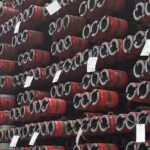
C110 Casing Pipe – High-Strength Sour Service Casing Solution

What Is C110 Casing Pipe?
C110 is a high-strength, controlled-yield sour-service casing grade defined under API 5CT, with a controlled yield strength of 110,000–120,000 psi and a minimum tensile strength of 115,000 psi. API 5CT C110 casing pipe is typically used in deep sour condensate, sour gas, and sour oil wells where higher strength and reliable H₂S resistance are required. Compared with conventional high-strength grades, C110 steel casing pipe offers a better balance of strength, hardness control, toughness, and sulfide stress cracking resistance for demanding downhole environments. As a reliable C110 casing pipe, it is suitable for intermediate and production casing strings in high-pressure sour-service wells; final application should be verified according to NACE MR0175 / ISO 15156 service conditions, since C110 is not suitable for all H₂S environments.
- Applicable Product: Casing Pipe 4½″–16″
- Thread Types: BTC / LTC / STC / Premium Connections.
- Available Lengths: R1 / R2 / R3.
- Service Environment:Sour Service (H₂S), SSC-tested per NACE TM0177, NACE MR0175 / ISO 15156.
C110 Casing Pipe Specifications
| Element | Chemical Composition, Mass Fraction % |
| C | ≤ 0.35 |
| Mn | ≤ 1.20 |
| Mo | 0.25–1.00 |
| Cr | 0.40–1.50 |
| Ni | ≤ 0.99 |
| P | ≤ 0.020 |
| S | ≤ 0.005 |
| Si | — |
| Cu | — |
| Property | Requirement |
| Yield Strength | 758–828 MPa / 110–120 ksi |
| Tensile Strength, min. | 793 MPa / 115 ksi |
| Total Elongation Under Load | 0.007 |
| Hardness, max. | 30 HRC / 286 HBW |
API 5CT / ISO 11960
C110 Casing — Inspection & Testing Requirements
A complete overview of the mandatory inspection and testing items for C110 grade OCTG casing, ensuring compliance with API 5CT and sour-service suitability.
MATERIAL
Chemical Analysis
Heat analysis and product analysis shall be performed. The manufacturer shall provide a heat analysis report for each heat of steel, including quantitative analysis of all elements used to control mechanical properties.
Reference: API 5CT §10
MECHANICAL
Tensile Test
Tensile properties shall be determined using longitudinal specimens at room temperature. Testing must conform to ISO 6892-1 or ASTM A370, covering yield strength, ultimate tensile strength, and elongation.
Reference: ISO 6892-1 / ASTM A370
MECHANICAL
Hardness Test
Through-wall hardness testing is required to verify sour-service suitability and heat-treatment uniformity. Measurements are taken at the OD, mid-wall, and ID surfaces to ensure values remain within specification limits.
Reference: API 5CT §10.6
MECHANICAL
Impact Test
Charpy V-notch impact testing is required in accordance with API 5CT requirements to evaluate toughness and resistance to brittle fracture under low-temperature and sour-service conditions.
Reference: API 5CT §10.7
METALLURGICAL
Grain Size Test
Prior austenitic grain size for C110 shall be ASTM No. 6 or finer, determined according to ISO 643 or ASTM E112. Fine grain size is critical for ensuring toughness and SSC resistance.
Reference: ISO 643 / ASTM E112
CORROSION
SSC Test (Sulfide Stress Cracking)
SSC resistance shall be evaluated using NACE TM0177. For C110, API allows Method A (tensile) and Method D (DCB). Method D testing has a maximum duration of 14 days to confirm sour-service suitability.
Reference: NACE TM0177 Method A & D
NDE
Nondestructive Examination (NDE)
Full-body, full-length NDE is required for C110 pipe, covering longitudinal and transverse flaw detection. Additional oblique (spiral) inspection is also mandated to detect helical defects.
Reference: API 5CT §13
PRESSURE
Hydrostatic Test
Each pipe shall be hydrostatically tested to the specified test pressure. Tester recorder charts documenting pressure hold time and peak pressure are part of the API 5CT inspection and certification package.
Reference: API 5CT §12
END FINISHING
End Inspection
After end finishing and before coupling installation, C110 pipe ends may require wet magnetic particle inspection (MPI) or another method agreed between purchaser and manufacturer to detect surface-breaking defects.
Reference: API 5CT §13
DIMENSIONAL
Dimensional, Visual & Marking Inspection
Pipes shall be inspected for conformance to specified dimensional tolerances and visual acceptance criteria, including:
- Outside diameter (OD) and wall thickness measurement
- Length measurement and weight verification
- Straightness and end squareness check
- Surface condition — visual inspection for defects, pits, cracks, and laminations
- Thread profile and gauge inspection (if applicable)
- Stenciling and color-band marking per API 5CT requirements
Reference: API 5CT §11 & §14
API 5CT C110 Casing for Sour Service
Sour Service Performance & SSC Resistance
Highest-Strength Sour-Service Grade
C110 Casing Pipe is the highest-strength grade qualified for sour service under NACE MR0175/ISO 15156. Its controlled chemistry and mandatory quench-and-temper heat treatment produce a tempered martensitic microstructure that resists sulfide stress cracking (SSC) at yield strengths up to 110 ksi.
SSC Qualification Testing
Qualification requires testing per NACE TM0177 Method A (uniaxial tensile) and Method D (DCB), with a maximum test duration of 14 days for DCB specimens. Through-wall hardness must not exceed 25.4 HRC at any point, and prior austenite grain size shall be ASTM No. 6 or finer.
Why C110 for H₂S Environments
C110 Sour Service Casing bridges the gap between lower-strength sour-service grades and non-sour P110. Where P110 lacks the metallurgical controls needed for H₂S environments, C110 delivers equivalent strength with full SSC resistance — making it the go-to choice for high-pressure sour wells.
C110 vs P110 Casing – Key Differences
A common question is: what is the difference between P110 and C110 Casing Pipe? Both grades share a 110 ksi minimum yield strength, but they are engineered for fundamentally different service environments. The table below summarizes the critical distinctions.
| Property | C110 | P110 |
|---|---|---|
| Yield Strength | 110 – 140 ksi | 110 – 140 ksi |
| Heat Treatment | Quench & Temper (mandatory) | Q&T or Normalization & Temper |
| Hardness Limit | ≤ 25.4 HRC (through-wall) | No through-wall requirement |
| SSC Testing (NACE TM0177) | Required — Method A & D | Not Required |
| Impact Testing | Full-size CVN required | Required (lower criteria) |
| Grain Size Requirement | ASTM No. 6 or finer | Not specified |
| NDE Inspection | Full-length longitudinal, transverse & oblique | Longitudinal & transverse only |
| Sour Service (NACE MR0175) | Fully Qualified | Not Qualified |
| Chemistry Control | Tight limits on C, Mn, Mo, Cr, Ni | Broader composition tolerances |
| Typical Application | High-pressure sour gas / CO₂ wells | Sweet-service, high-collapse wells |
The additional metallurgical controls in C110 — mandatory Q&T, through-wall hardness limits, grain size requirements, and SSC qualification — add cost but eliminate the risk of environmental cracking. For any well with confirmed H₂S content, C110 is the only 110 ksi option that meets NACE MR0175 requirements.
C110 is a sour service grade with stricter chemistry, heat treatment, and hardness limits (HRC ≤25.4) compared to P110. C110 is qualified for H2S environments per NACE MR0175, while P110 is not rated for sour service
API 5CT is the industry specification for casing and tubing. C110 is a grade within this spec, designed for high-strength (110 ksi yield) sour service applications with mandatory SSC testing.
C110 supports standard API connections (BTC, LTC, STC) and premium gas-tight connections. Premium connections are recommended for sour service to ensure seal integrity under H2S exposure.
C110 resists Sulfide Stress Cracking (SSC) in high-H2S environments. Its controlled hardness, refined microstructure, and mandatory NACE qualification make it the preferred choice for sour gas wells.