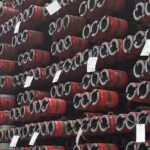
R95 Casing Pipe – High-Strength API 5CT Steel Casing for Deep-Well Operations

What Is R95 Casing Pipe?
R95 casing pipe is a high-strength steel grade defined under API 5CT, with a controlled yield strength of 95,000–110,000 psi and a minimum tensile strength of 105,000 psi. R95 casing was developed for oil and gas wells requiring higher mechanical strength than N80, while offering a cost-effective alternative to sour-service grades such as T95 when sulfide stress cracking resistance is not required. It is commonly used in medium-to-deep wells, high-pressure formations, and general oilfield casing applications where reliable collapse and burst performance are important.
- Applicable Product: Casing & Tubing.
- Thread Types: BTC / LTC / STC / Premium Connections.
- Available Lengths: R1 / R2 / R3.
- Service Environment: Suitable for high-pressure oil and gas wells; not recommended for severe sour H₂S service.
R95 Casing Pipe Specifications & Mechanical Properties
Chemical Composition
| Grade | C | Mn | P max | S max | Si max |
| R95 | API limit not specified | 0.45–1.90% | 0.03% | 0.03% | 0.45% |
Mechanical Properties
| Grade | Yield Strength | Tensile Strength min | Total Elongation Under Load | Hardness Limit |
| R95 | 655–758 MPa / 95,000–110,000 psi | 724 MPa / 105,000 psi | 0.5% min | No API hardness limit |
Mandatory Inspection & Testing Requirements for API 5CT R95 Casing Pipe
A clear overview of every inspection and test required before delivery — ensuring your R95 casing meets full API 5CT compliance.
Why Inspection & Testing Matter for R95 Casing
API 5CT R95 casing pipe is designed for demanding downhole environments. Before any pipe leaves the mill, it must pass a series of mandatory inspections and tests defined by API 5CT. These checks verify that every length of R95 casing meets the required mechanical properties, dimensional tolerances, and surface quality — protecting well integrity and operational safety.
Below is a breakdown of each required inspection and test, explained in plain terms so you know exactly what to expect and what to specify on your purchase order.
Required Inspections & Tests — At a Glance
Chemical Analysis
Verification of heat and product chemical composition — confirming elements like C, Mn, Mo, Cr, and S/P limits meet the R95 grade specification.
Tensile Test
Measures yield strength (95–110 ksi), ultimate tensile strength (≥ 105 ksi), and elongation. All values must fall within API 5CT R95 limits.
Dimensional Inspection
Checks outer diameter, wall thickness, length, straightness, weight, and end dimensions against API tolerances for every pipe.
Full-Length Drift Test
A drift mandrel is passed through the entire length of each pipe to confirm unobstructed internal clearance. Required on 100 % of pipes per API 5CT Addendum 1.
Visual Inspection
Internal and external surfaces are examined for defects such as cracks, pits, seams, laps, or any imperfection that could affect pipe performance.
Non-Destructive Examination (NDE)
Pipe body NDE — including ultrasonic or electromagnetic testing — performed per API 5CT requirements and any additional purchase-order conditions.
Hydrostatic Test
Each pipe is pressurized with water to a specified test pressure and held for a set duration — verifying leak-tightness and pressure integrity. Required per product form and order conditions.
Thread Inspection
API thread gauging on pin and box ends plus coupling inspection — all performed in accordance with API 5B and API 5CT to ensure proper make-up and seal integrity.
Marking & Coating Inspection
Verifies correct pipe marking (stencil & die stamp), color coding, protective coating, thread compound application, and protectors are all in place per API 5CT.
API 5CT R95 Inspection & Testing Summary Table
The table below lists every mandatory check, the applicable standard, and what is being verified — a quick reference you can use when reviewing mill test reports or writing purchase-order requirements.
| # | Test / Inspection | Reference Standard | What Is Verified |
|---|---|---|---|
| 1 | Chemical Analysis | API 5CT | Heat & product chemical composition (C, Mn, Mo, Cr, S, P, etc.) |
| 2 | Tensile Test | API 5CT | Yield strength 95–110 ksi, UTS ≥ 105 ksi, elongation |
| 3 | Dimensional Inspection | API 5CT | OD, wall thickness, length, straightness, weight, end dimensions |
| 4 | Full-Length Drift Test | API 5CT Add. 1 | 100 % drift — mandrel through entire pipe length |
| 5 | Visual Inspection | API 5CT | Internal & external surface condition — no harmful defects |
| 6 | NDE | API 5CT / PO | Pipe body ultrasonic or electromagnetic examination |
| 7 | Hydrostatic Test | API 5CT / IOGP | Pressure integrity & leak-tightness under specified test pressure |
| 8 | Thread Inspection | API 5B / 5CT | Thread gauging (pin & box), coupling inspection, seal integrity |
| 9 | Marking & Coating | API 5CT | Stencil/die stamp, color code, coating, thread compound, protectors |
R95 vs. T95 vs. P110 — How to Choose the Right Casing Grade
All three are API 5CT casing grades for deep wells, but they serve very different conditions. This guide helps you pick the right one based on well environment, pressure, and H₂S exposure.
Side-by-Side Comparison
The table below puts R95, T95, and P110 next to each other on every key property. R95 steel casing pipe offers the best balance of strength and cost when hydrogen sulfide is not a concern.
| Feature | R95 | T95 | P110 |
|---|---|---|---|
| Yield Strength | 95 – 110 ksi | 95 – 110 ksi | 110 – 140 ksi |
| SSC Testing | Not Required | Required | Not Required |
| Hardness Testing | Not Required | Required | Not Required |
| H₂S Suitability | No | Yes | No |
| Relative Cost | Medium | Higher | Higher |
| Best For | Deep non-sour wells | Sour-service wells (H₂S) | Ultra-deep / high-pressure wells |
Grade Profiles — When to Use Each
R95
Best Balance of Strength & Cost
R95 delivers 95–110 ksi yield strength without the added cost of sour-service testing. It is the go-to grade for deep wells where hydrogen sulfide is not present.
- Non-sour deep & intermediate casing strings
- No SSC or hardness testing overhead
- Lower per-tonne cost than T95 and P110
- Widely available in common OD/WT sizes
T95
Engineered for Sour Service
T95 shares the same 95–110 ksi yield range as R95, but adds mandatory SSC testing and hardness limits — making it compliant with NACE MR0175 / ISO 15156 for H₂S environments.
- Required when H₂S is present in the well
- SSC tested per NACE TM0177
- Hardness controlled ≤ 25.4 HRC
- Higher cost due to additional QC requirements
P110
Maximum Strength for Extreme Pressure
P110 raises the yield floor to 110 ksi (up to 140 ksi), providing the highest burst and collapse resistance in the standard API 5CT lineup — but at a premium price and with no sour-service rating.
- Ultra-deep wells with extreme hydrostatic loads
- HPHT (high-pressure, high-temperature) applications
- Not suitable for H₂S environments
- Higher material & inspection cost
Quick Decision Guide
Answer one question at a time to arrive at the right grade for your well.
Is H₂S present in the well?
If yes → choose T95. It is the only grade among the three that is sour-service rated. R95 and P110 are not designed for H₂S exposure.
Do you need yield strength above 110 ksi?
If yes → choose P110. Its 110–140 ksi range handles ultra-deep, high-pressure wells where R95 and T95 (both capped at 110 ksi) may not provide enough burst or collapse resistance.
No H₂S and 95–110 ksi is sufficient?
Then R95 is your best option. It provides the same yield range as T95 at a lower cost, without paying for sour-service testing you do not need.
R95 has a minimum yield strength of 655 MPa (95 ksi) and a maximum of 758 MPa (110 ksi), per API 5CT specifications.
Both share identical yield and tensile strength ranges, but T95 requires SSC (sulfide stress cracking) and hardness testing, making it suitable for sour (H₂S) environments. R95 does not require these tests and is a more cost-effective option for sweet wells.
R95 is not designed for sour service. For wells with H₂S exposure, consider L80, C90, or T95 grades that include mandatory SSC resistance testing.
R95 must be quenched and tempered (Q&T). After final tempering, R95 casing shall not be stretched or expanded, except for normal straightening with no more than 3% compression cold working.