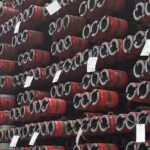
L80 9Cr Casing Pipe

L80 9Cr is a chromium-alloy grade defined in API 5CT, containing approximately 9% chromium for enhanced corrosion resistance. It is designed for mildly to moderately corrosive well environments where CO₂ and low-concentration H₂S are present. L80 9Cr must be heat-treated (quenched and tempered) and meets strict hardness requirements, making it suitable for sour service applications under NACE MR0175/ISO 15156.
- Applicable Product: Casing & Tubing 2-3/8″–20″.
- Thread Types: BC, STC / LTC, Premium Connections.
- Available Lengths: R1 / R2 / R3.
- Heat Treatment: Quench & Temper (Q&T) required per API 5CT.
- Service Environment: CO₂-bearing and mild H₂S (sour) wells; not for high-alloy sour service.
API 5CT L80-9Cr Specification & Standards
| Grade | Chemical Composition % | ||||||||
| C | Si | Mn | P | S | Cr | Mo | Ni | Cu | |
| L80 9Cr | ≤0.15 | ≤1.00 | 0.30–0.60 | ≤0.020 | ≤0.010 | 8.00–10.00 | 0.90–1.10 | ≤0.50 | ≤0.25 |
| Grade | Yield Strength MPa | Tensile Strength MPa | Elongation % | Hardness max | ||
| min | max | min | min | HRC | HBW | |
| L80 9Cr | 552 | 655 | 655 | ≥19% | 23 | 241 |
Quality Control & Assurance
Reference Inspection For L80 9Cr Casing And Tubing
L80 9Cr is a 9% chromium alloy grade per API 5CT, designed for CO₂ and mild H₂S well environments. Below are the key inspection categories and focus points for procurement and receiving.
Material Verification
Cross-check heat number, lot number, grade, and manufacturing process. Confirm the marking reads L80 9Cr / L9 — rule out any confusion with L80-1 or L80 13Cr. Verify quench & temper (Q&T) heat treatment status.
Chemical Composition
Primary focus on Cr content ≈ 8–10% as the defining element. Also verify C, Mn, Mo, Ni, P, S, and Si against both heat (ladle) analysis and product analysis reports.
Tensile Testing
L80 series requires YS 552–655 MPa and TS ≥ 655 MPa. L80 9Cr follows the same strength-class controls. Elongation must meet the API 5CT minimum value for the applicable wall thickness.
Hardness Testing
L80 imposes a maximum hardness limit of 23 HRC / 241 HBW. Cross-section hardness surveys are required. Hardness is one of the critical release criteria for L80 9Cr products.
NACE MR0175Impact Testing
Charpy V-notch test performed per standard, purchase order, or temperature requirements. Specify test temperature, specimen orientation, and minimum absorbed energy at the time of procurement.
Hydrostatic Testing
Each pipe is individually hydrostatically tested. Test pressure is calculated per API 5CT and the applicable size/weight specification. Confirm hold time and pressure records are complete.
Non-Destructive Examination
Full-length body NDE: UT, flux leakage, eddy current, and/or magnetic particle. Body NDE is critical for heat-treated L80 grades. Under IOGP S-735, full-body UT plus supplementary surface methods may be required.
JIP33 IOGP S-735Dimensional Inspection
Verify OD, wall thickness, ovality, length, weight, and end dimensions. Size, weight class, and range length (R1/R2/R3) must match the purchase order.
Visual Inspection
Examine ID/OD surfaces for defects, scratches, dents, laps, cracks, and corrosion. 9Cr material requires extra attention to surface contamination, mechanical damage, and protective measures.
Straightness Check
Inspect total-length straightness and end straightness. Pay particular attention to tubing and premium connection pipes where tighter end-straightness tolerances apply.
Drift Testing
Both casing and tubing must pass a drift mandrel test per specification. Confirm drift mandrel dimensions comply with API 5CT or the purchase order requirements.
Thread Inspection
Check thread parameters: standoff, taper, thread form, pitch, and coating/phosphating/surface condition. API connections per API 5B; premium connections per manufacturer specifications.
Coupling Inspection
Inspect coupling material, thread, make-up torque, marking, coating, and sealing surfaces. When shipped with couplings attached, each coupling must have corresponding inspection and traceability records.
Marking & Documentation
Verify stencil markings, color bands, MTC, NDE reports, heat treatment records, and hydrostatic test records. L80 9Cr color bands and markings must match the applicable standard or PO. Full traceability is mandatory.
Grade Selection Guide
When to Choose L80 9Cr Casing Pipe
L80 9Cr sits in a sweet spot between carbon-steel grades and 13Cr — offering meaningful CO₂ corrosion resistance at a lower cost than full martensitic stainless steel. This guide helps you decide whether 9Cr is the right fit for your well conditions.
← Lower cost · Less corrosion resistance
Higher cost · More corrosion resistance →
L80 9Cr — more CO₂-resistant than carbon steel, more affordable than 13Cr.
The practical “middle ground” for CO₂-dominant, low-H₂S wells.
Decision Logic
Grade Selection Flowchart
Follow this simplified decision tree to determine if L80 9Cr is the right choice for your well.
Why L80 9Cr
Key Advantages Over Adjacent Grades
L80 9Cr delivers targeted value in three areas where carbon steel falls short and 13Cr may be over-specified.
CO₂ Corrosion Resistance
9% chromium forms a protective Cr-oxide layer that significantly reduces CO₂ corrosion rates compared to plain carbon steel — without the full cost of 13Cr martensitic stainless.
Cost-Effective Alternative
Typically 30–50% less expensive than 13Cr, with shorter lead times. When well conditions don’t demand full CRA performance, 9Cr avoids over-engineering the material selection.
Sour Service Qualified
Meets NACE MR0175 / ISO 15156 hardness limits (23 HRC max). Suitable for mild sour environments where carbon steel grades L80-1 or N80 would also qualify but lack CO₂ protection.
Grade Comparison
L80 9Cr vs. Common Alternatives
A quick side-by-side to help you weigh L80 9Cr against the grades it most often competes with.
| Property | L80-1 / N80 | 3Cr | L80 9Cr ★ | 13Cr (L80) | S13Cr |
|---|---|---|---|---|---|
| CO₂ Resistance | Low | Moderate | Good | Very Good | Excellent |
| H₂S Tolerance | Sour (NACE) | Mild sour | Mild sour | Moderate sour | Moderate sour |
| Yield Strength | 80 ksi | 80 ksi | 80 ksi | 80 ksi | 80–110 ksi |
| Hardness Limit | 23 HRC | 22 HRC | 23 HRC | 23 HRC | Varies |
| Relative Cost | $ | $ – $$ | $$ | $$$ | $$$$ |
| Lead Time | Short | Short | Medium | Longer | Longest |
| Best For | Sweet / mild wells | Low CO₂ wells | CO₂-dominant, budget-limited | CO₂ + moderate H₂S | High CO₂ + H₂S |
Real-World Scenarios
When L80 9Cr Is — and Isn’t — the Right Call
Practical examples to help match your well conditions to the right grade decision.
✓ CHOOSE L80 9CR
CO₂-Flood EOR Well
High CO₂ partial pressure from enhanced oil recovery injection, minimal H₂S. Carbon steel corrodes too fast; 13Cr budget not approved. 9Cr cuts corrosion rate by 80–90% vs. N80.
✓ CHOOSE L80 9CR
Deep Gas Well — Low H₂S
High-temperature CO₂ environment, < 0.05 psi H₂S partial pressure. Inhibitor treatment is impractical at depth. 9Cr provides passive corrosion protection without chemical intervention.
✗ SKIP L80 9CR
High H₂S Sour Gas Well
H₂S partial pressure exceeds mild sour limits. 9Cr’s chromium content doesn’t provide sufficient SSC resistance at elevated H₂S. Use 13Cr, S13Cr, or duplex CRA instead.
✗ SKIP L80 9CR
Shallow Sweet Well — Tight Budget
Low CO₂, no H₂S, low temperature. Standard L80-1 or N80 with a corrosion inhibitor program is far more economical. 9Cr adds cost without meaningful benefit.
L80 9Cr contains about 8–10% Cr, while L80 13Cr contains about 12–14% Cr. L80 13Cr generally offers better CO₂ corrosion resistance and is used for more corrosive sweet-service wells. L80 9Cr is usually selected for moderate CO₂ corrosion where 13Cr is not economically necessary.
API Spec 5CT or ISO 11960.
| Product | Common OD range |
|---|---|
| Casing | 4-1/2 in. to 20 in. |
| Tubing | 1.050 in. to 4-1/2 in. |
L80 9Cr casing and tubing are inspected according to API 5CT and purchase order requirements. Common inspection items include MTC review, chemical analysis, tensile test, hardness test, hydrostatic test, NDE, dimensional inspection, drift test, visual inspection, marking verification, and thread inspection for API or premium connections. For 9Cr material, special attention should be given to chromium content, hardness control, pipe body defects, surface condition, and full traceability.