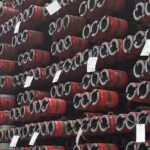
M65 Casing Pipe: API 5CT Specification, Properties & Applications

What Is M65 Casing Pipe?
M65 is a medium-strength casing grade defined in API 5CT, offering a minimum yield strength of 65,000 psi (448 MPa) and a minimum tensile strength of 85,000 psi (586 MPa). It is the only general-purpose casing grade with a restricted maximum hardness requirement, produced through normalizing or quenching-and-tempering heat treatment. Its controlled hardness makes it well suited for wells where toughness and consistent mechanical properties are required in non-sour service environments.
- Applicable Product:Casing & Tubing 4½″–20″.
- Thread Types: STC, LTC / BTC.
- Available Lengths: R1 / R2 / R3.
API 5CT M65 Chemical Composition & Mechanical Properties
Grade M65 is a legacy API 5CT grade. API announced that the 10th edition eliminated Grade M65 entirely from API Spec 5CT; the current 11th edition is now the monogram basis for products manufactured on or after January 1, 2025. Use the values below only when working to an older/API 5CT M65 purchase specification or legacy MTR.
Chemical Composition
| Grade | C (max%) | Mn (max%) | P (max%) | S (max%) | Ni (max%) | Cu (max%) | Heat Treatment |
| M65 | — | — | 0.030 | 0.030 | — | — | Normalized / N&T/Q&T |
Mechanical Properties
| Grade | Yield (psi / MPa) | Tensile Min (psi / MPa) | Hardness Max | Impact Test (0°C) |
| M65 | 65–85 ksi / 448–586 | 85 ksi / 586 | 22 HRC / 235 HBW | Not Required |
Test requirements
| Steel Grade | Mandatory Tests | Supplementary Tests | NDT | Corrosion Test | Key Control Requirements |
| M65 | Chemical analysis, Tensile, Hardness, Hydrostatic pressure | SSC | UT+MT | NACE TM0177 | Hardness ≤ 22HRC |
Why Was the M65 Casing Replaced?
API 5CT 10th Edition officially eliminated Grade M65, and the upcoming 11th Edition confirms its removal. Below are the five key reasons why M65 lost its place in the standard.
1 Awkward Position in the Strength Spectrum
M65 sits at 65 ksi minimum yield strength — squarely between the low-cost J55/K55 tier and the widely used N80/L80 tier. In practice, operators who need economy choose J55/K55; those who need more strength jump directly to N80 or L80. M65 offers no compelling cost-performance advantage in either direction.
| Grade | Min. Yield Strength | Typical Positioning |
|---|---|---|
| J55 / K55 | 55 ksi | Shallow wells, general casing, lowest cost |
| M65 | 65 ksi | Mid-range strength — narrow application window |
| N80 / L80 | 80 ksi | Mid-to-deep wells, production casing, broad use |
| P110 | 110 ksi | Deep wells, high-load environments |
2 Hardness Restriction Without a Clear Sour-Service Role
M65 is the only general-purpose casing grade with a restricted maximum hardness (~22 HRC / 235 HBW). This makes it look like a controlled-hardness grade — but it was never positioned as a true sour-service steel.
For H₂S and acidic environments, the industry relies on L80, C90, T95, and C110, all of which are explicitly built around NACE MR0175 / SSC testing requirements. API’s 10th Edition updates further reinforced the hardness specifications for these sour-service grades.
M65 carries the cost of hardness control but lacks the clear sour-service market position that L80 and higher grades offer.
3 No Meaningful Cost Advantage
M65 requires full-body heat treatment — normalizing, normalizing + tempering, or quenching & tempering. This makes it significantly more expensive to produce than as-rolled J55/K55.
Yet its 65 ksi yield delivers only a modest strength bump over the lower grades, while remaining well below the 80 ksi threshold. The result is a grade that costs nearly as much to manufacture as L80/N80 but offers less performance in return.
Common buyer reasoning: “If we’re paying for heat treatment and controlled properties anyway, we’d rather go straight to L80 or N80.”
4 Modern Well Designs Have Moved Beyond 65 ksi
Today’s oil and gas wells are increasingly deep, horizontal, and subject to high-pressure fracturing and complex loads. These conditions demand casing with higher tensile and collapse resistance, anti-SSC capability, and proprietary high-performance grades.
For shallow or surface casing where 65 ksi is more than enough, J55/K55 is the proven, cost-effective choice. The design window where M65 fits — moderate-depth, non-sour, non-extreme loading — has shrunk with modern drilling practices.
5 Removal from API 5CT Creates Procurement Barriers
Since M65 was eliminated from the current API 5CT edition, any project that still requires M65 must procure it under older editions, buyer-seller agreements, or manufacturer-specific specifications.
API’s guidelines for the 11th Edition (effective January 1, 2025) make clear that only products conforming to the latest edition can carry the API Monogram. This means newly manufactured M65 pipe can no longer be stamped or certified as a current API 5CT grade — making it harder to source, audit, and approve for new projects.
New M65 production cannot carry the API Monogram under the current standard, complicating procurement and quality certification for operators.
M65 Casing Applications
Applications of M65 Steel Casing Pipe in Oil & Gas
M65 casing pipe is primarily deployed in surface and intermediate casing strings for onshore and offshore wells. Its medium-strength profile and controlled hardness make it a dependable choice across a range of drilling scenarios.
Surface Casing
Installed at shallow depths to protect freshwater aquifers and provide structural support for the wellhead. M65’s balanced strength prevents collapse under surface formation pressures.
Intermediate Casing
Isolates unstable formations and abnormal pressure zones at moderate depths. M65’s restricted hardness ensures consistent mechanical performance throughout the casing string.
Oil Well Drilling
Provides reliable wellbore integrity for crude oil extraction in non-corrosive, non-sour service environments. A cost-effective alternative to higher-grade alloys where H₂S is absent.
Natural Gas Extraction
Suited for sweet gas wells at shallow to moderate depths. M65 casing maintains structural integrity under gas-well operating pressures while keeping project costs manageable.
Water Well Construction
Applied in deep water wells requiring medium-strength steel. M65’s toughness protects the wellbore from formation pressure and prevents contamination of surrounding groundwater.
Oil & Gas Transportation
Used in short- to medium-distance pipeline segments for transporting hydrocarbons from the wellhead, leveraging M65’s weldability and mechanical reliability.
M65 casing pipe has a minimum yield strength of 448 MPa (65 ksi) and a maximum of 586 MPa (85 ksi), as specified in API 5CT. This medium-strength range makes it suitable for standard well casing applications.
M65 has a lower yield strength range (448–586 MPa) compared to N80 (552–758 MPa). M65 also requires a restricted maximum hardness of 22 HRC, whereas N80 does not have this hardness limit. M65 is selected for wells needing controlled hardness properties.
STC (Short Thread), LTC (Long Thread), and BTC (Buttress Thread) connections per API 5B.
Standard outside diameters range from 4-1/2″ (114.3 mm) to 20″ (508 mm), with wall thickness varying by application. Length ranges include R1, R2, and R3 as defined by API 5CT.
M65 is classified as a general-purpose grade and is not specifically designed for sour service environments. For wells with H₂S exposure, grades like L80 or C90 with SSC testing are recommended.